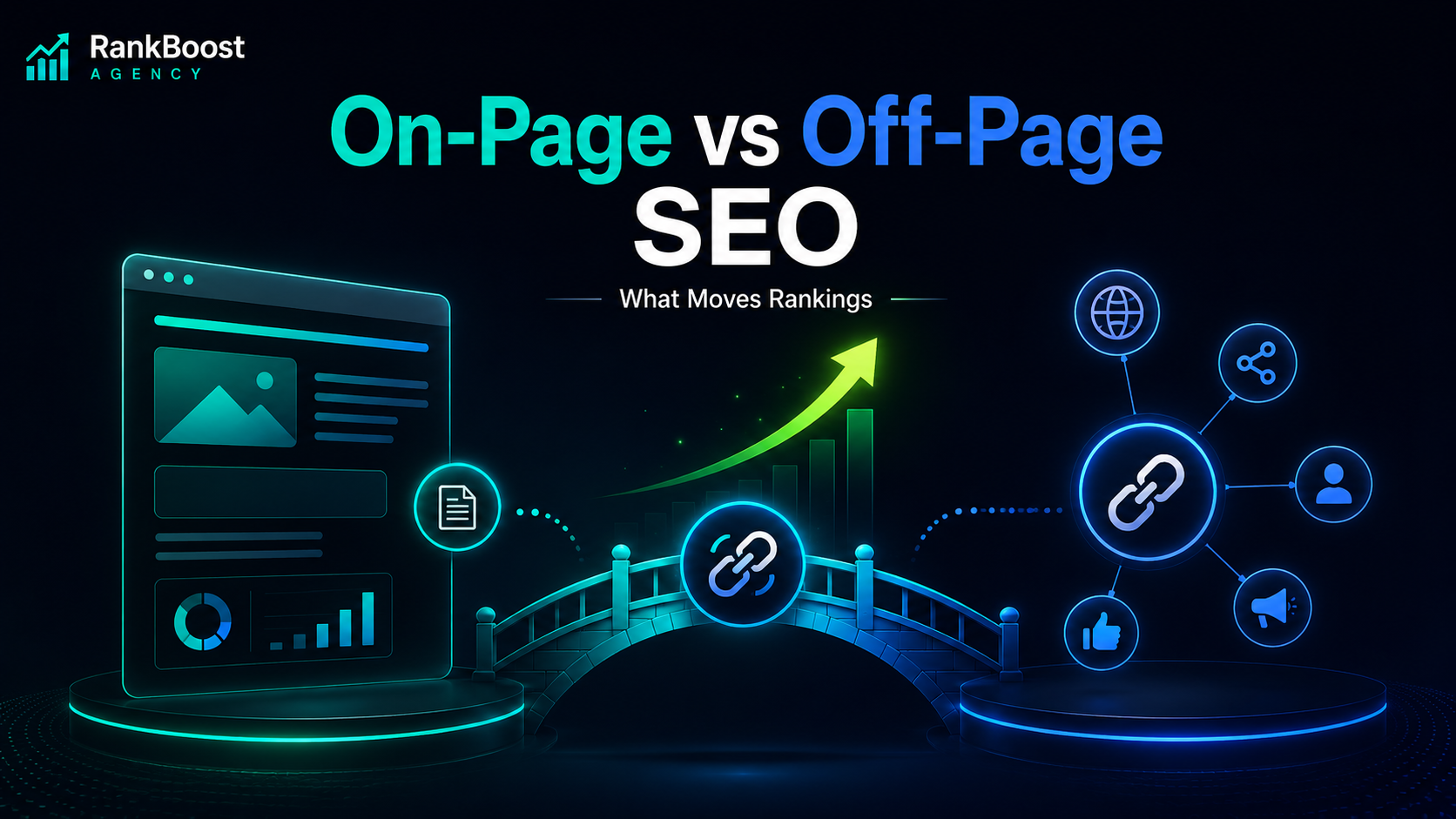
Most SEO explanations treat on-page vs off-page SEO like a coin flip - pick one, do it well, move on. That's not how search works.
The truth is that on page vs off page seo are two halves of the same strategy, and getting only one right will cap your results. You might have a technically flawless site with no authority behind it. Or a mountain of backlinks pointing to content that doesn't deserve to rank. Neither extreme wins.
This guide breaks down exactly what each type of SEO involves, how they interact, and where most sites are actually leaking ranking potential. If you're a startup founder trying to prioritize limited resources, or a marketing manager auditing your current SEO program, you're in the right place.
What Is On-Page SEO?
On-page SEO covers everything you can control directly on your website. That includes the content itself, how it's structured, the technical signals you embed in the HTML, and how easy the page is to use.
Think of it this way: on-page SEO tells search engines what your page is about and whether it deserves to rank for a specific query. If your page is thin, confusing, or slow to load, no amount of external effort will consistently push it to the top.
The core elements of on page seo include:
- Title tags and meta descriptions - These are your first impression in search results. Your primary keyword should appear naturally in the title tag, ideally toward the beginning.
- Header structure (H1, H2, H3) - Headers help Google understand your page's hierarchy and topics. Each page should have one H1, and your H2s should cover the main subtopics a reader would expect.
- Keyword placement - Your target keyword should appear in the first 100–150 words, in at least one H2, and a handful of times throughout the body without stuffing.
- Content quality and depth - Google's Helpful Content system rewards pages that fully satisfy a searcher's intent. Thin content that skims the surface gets outranked by pages that actually answer the question.
- Internal linking - Linking from one page on your site to another passes link equity and helps Google discover and contextualize your content.
- URL structure - Clean, descriptive URLs (e.g., /on-page-vs-off-page-seo/) perform better than long, parameter-heavy strings.
- Image optimization - Alt text, file size, and image format all affect both accessibility and page speed.
- Page speed and Core Web Vitals - Google has made page experience a ranking signal. Largest Contentful Paint (LCP), Cumulative Layout Shift (CLS), and Interaction to Next Paint (INP) directly affect rankings.
- Mobile usability - With mobile-first indexing, Google primarily uses the mobile version of your site for ranking decisions.
- Schema markup - Structured data helps Google understand your content type and can generate rich results (star ratings, FAQs, breadcrumbs) in the SERPs.
On-page SEO is largely within your control. That's a strength, but it also means there's no excuse for leaving it undone.
What Is Off-Page SEO?
Off-page SEO refers to everything that happens outside your website that influences how search engines perceive your authority and trustworthiness. The most well-known piece is backlinks, but off page seo extends further than most people realize.
Here's a practical breakdown of what falls under off-page SEO:
- Backlinks - When other websites link to yours, they pass what's known as "link equity" or "PageRank." Google treats high-quality backlinks as votes of confidence. A link from a respected industry publication means far more than a dozen links from low-quality directories.
- Domain authority - This is a cumulative score reflecting the strength of your overall backlink profile. It's not a Google metric, but it's a useful proxy for how competitive your site is in a given niche.
- Brand mentions - Even unlinked mentions of your brand across the web may contribute to Google's understanding of your authority. These are sometimes called implied links.
- Digital PR - Earning coverage in news outlets, trade publications, or industry blogs builds both visibility and backlinks simultaneously.
- Social signals - Social shares don't directly affect rankings, but they increase content reach, which often leads to more people linking to it organically.
- Guest posting - Publishing articles on relevant third-party sites with a link back to your own is one of the most reliable methods of controlled link building.
- Local citations - For businesses with physical locations, consistent NAP (Name, Address, Phone) listings across directories like Google Business Profile, Yelp, and industry-specific directories is a core off-page signal for local rankings.
- Forum and community participation - Providing genuine value in places like Reddit, Quora, or niche forums can drive referral traffic and the occasional link.
The fundamental difference between on-page and off-page SEO is control. On-page is fully in your hands. Off-page depends on what others do in response to your content and reputation.
The Difference Between On-Page and Off-Page SEO: A Side-by-Side Look
The easiest way to understand how these two disciplines compare is to see them together:
| Factor | On-Page SEO | Off-Page SEO |
|---|---|---|
| Location | Your website | External sites and signals |
| Control | High | Moderate to low |
| Primary goal | Relevance and content quality | Authority and trust |
| Key tactics | Keywords, content, speed, technical | Backlinks, PR, brand mentions |
| Time to see results | Relatively fast (weeks) | Slower (months) |
| Affected by you directly | Yes | Partially |
| Affected by others | Rarely | Frequently |
Both types are necessary. On-page SEO determines what you rank for. Off-page SEO plays a major role in how high you rank, especially in competitive keyword spaces.
Why Both Types of SEO Are Non-Negotiable
A common mistake is treating on page and off page seo as an either/or decision. In practice, neglecting either one creates a ceiling on what you can achieve.
Here's what each scenario actually looks like:
Strong on-page, weak off-page: Your pages are well-structured, fast, and thorough. But without authoritative backlinks, Google has limited reason to trust your site over established competitors. You'll likely rank for low-competition, long-tail terms but struggle to break into competitive SERPs.
Strong off-page, weak on-page: You have backlinks from reputable domains, but the pages they point to are thin, slow, or confusing. Google can tell. Users bounce - and poor conversion rate optimization means that traffic rarely turns into leads either. Rankings plateau despite the link equity.
Both in balance: You rank for your target terms, you're competitive against bigger players, and your gains compound over time as new links reinforce good content - and good content attracts more links.
As Rand Fishkin, co-founder of Moz, put it: "The best SEO strategy is one that makes the experience better for users and earns links as a natural result of that."
That quote captures something important. The difference between on page and off page seo isn't really about competition between them - it's about sequencing and proportion.
How to Prioritize On-Page vs Off-Page SEO
Where you start depends on the current state of your site, your competition level, and your resources.
Start with on-page if:
- Your site is new or recently launched
- You haven't done a technical SEO audit in over a year
- Your existing content doesn't rank for anything meaningful
- You're targeting niche or low-competition keywords
Shift focus to off-page if:
- Your on-page foundation is solid and your technical health is clean
- You're competing against established brands in your niche
- Your content already ranks on page 2 or 3 and needs a push
- You're in a highly competitive industry like finance, legal, health, or ecommerce
For most growing businesses, the right approach is to build on-page fundamentals first, then systematically pursue off-page authority building. Trying to scale link building before your site is ready just wastes budget.
Before investing heavily in either strategy, many businesses benefit from completing a brand audit to identify messaging issues, content gaps, technical weaknesses, and opportunities that should be addressed first.
If You're Not Sure Where Your SEO Gaps Are, Get a Proper Audit
This is where honest advice is worth more than a checklist. Most sites have a mix of on-page and off-page gaps, and guessing which to fix first is an expensive exercise.
At RankBoost Agency, we run comprehensive SEO audits that map out exactly where your site is losing ground - whether that's technical issues suppressing crawlability, thin content failing to satisfy search intent, or a backlink profile that isn't competitive for your target keywords. From there, we build a prioritized roadmap, not a generic to-do list. If you want that kind of clarity before committing to a strategy, book a call and we'll walk through it with you.
On-Page SEO Best Practices Worth Following in 2026
On-page SEO has evolved. Some tactics that worked five years ago now either don't matter or actively hurt. Here's what's actually worth your time today:
Write for Search Intent, Not Just Keywords
The single most important on-page shift in recent years is understanding intent. Google doesn't just match keywords - it tries to understand what kind of result the user is looking for: an article, a product page, a comparison, a definition.
If someone searches "best project management software," they want a listicle with comparisons, not a homepage. If they search "what is project management software," they want a clear explanation. Matching your content format to the user's intent is now more important than keyword density.
Fix Technical Issues Before Creating More Content
Duplicate content, broken internal links, missing canonical tags, slow pages, and crawl errors all limit how well your site performs. Publishing more content on top of unresolved technical problems is like pouring water into a leaky bucket. Run a site audit first.
Internal Linking Is Underused
Most sites underinvest here. A deliberate internal link structure passes authority from high-value pages (like your homepage or a popular post) to pages you want to rank. It also helps Google understand your site's topical authority when done consistently across a content cluster.
Off-Page SEO Best Practices That Hold Up
The fundamentals of off page seo haven't changed dramatically, but the bar for what counts as a quality link has risen considerably.
Quality Over Quantity in Link Building
A single editorial link from a well-regarded industry site is worth more than 20 links from low-authority blogs or paid link schemes. Google's algorithms have gotten significantly better at detecting manipulative link patterns. Focus on relevance and editorial context, not raw link volume. Our link building service is built around exactly that approach.
Use Digital PR as a Link Building Engine
Digital PR - pitching original data, expert commentary, or newsworthy angles to journalists and editors - is one of the most scalable ways to earn legitimate backlinks. Done well, one solid PR campaign can generate dozens of links from news outlets and industry publications simultaneously.
Don't Ignore Brand Mentions
Tools like Google Alerts, Ahrefs, or Brand24 can flag when someone mentions your business without linking to you. Reaching out to convert unlinked brand mentions into actual backlinks is a high-ROI activity that most sites overlook.
Local SEO Is Its Own Off-Page Category
If your business serves a specific geography, on off page seo rules apply differently. Local rankings depend heavily on your Google Business Profile, the volume and quality of your reviews, and consistent citations across local directories. This is off-page SEO with a geographic layer added.
On-Page vs Off-Page SEO: Where Most Sites Actually Fail
After looking at hundreds of sites, the failure patterns are consistent.
On the on-page side, the most common problems are: targeting keywords your site isn't competitive enough to rank for, content that's structured for search engines instead of readers, and ignoring technical issues because they're not visible to users.
On the off-page side, the most common problems are: no link-building strategy at all (relying entirely on organic discovery), pursuing quantity over quality in outreach, and treating link building as a one-time campaign rather than an ongoing investment.
The sites that consistently outperform their size and budget tend to do three things: publish content that's demonstrably better than what's already ranking, build links steadily over time through legitimate outreach and PR, and stay on top of technical hygiene so none of those efforts get wasted.
Frequently Asked Questions
What is the main difference between on-page and off-page SEO?
On-page SEO focuses on optimizing elements within your website - content, keywords, technical performance, and site structure. Off-page SEO involves building your site's authority through external signals, primarily backlinks, brand mentions, and digital PR. Both affect your search rankings but in different ways.
Which is more important: on-page or off-page SEO?
Neither is universally more important. On-page SEO determines what you rank for; off-page SEO influences how high you rank, especially in competitive niches. In practice, you need a solid on-page foundation before off-page efforts will have maximum impact.
Can I rank without backlinks using on-page SEO alone?
Yes, but with limitations. For low-competition and long-tail keywords, strong on-page SEO can be enough to rank. For competitive terms - especially in crowded industries - backlinks are a significant ranking factor and difficult to avoid needing.
How long does off-page SEO take to show results?
Off-page SEO typically takes longer than on-page improvements. Backlinks need to be discovered and processed by Google, which can take weeks to months. A consistent link-building program generally shows measurable ranking improvements within three to six months.
What are the best off-page SEO tactics for a new website?
For a new site, the most effective off-page tactics are: earning editorial links through guest posting on relevant sites, building local citations if you serve a specific area, pursuing digital PR with original data or stories, and converting brand mentions into backlinks. Avoid paid link schemes - they carry long-term risk that outweighs short-term gains.
Conclusion
Understanding on page vs off page seo isn't just a theory exercise. It changes how you budget your time, where you assign resources, and what results you can realistically expect and when.
On-page SEO gives you relevance. Off-page SEO gives you authority. You need both to compete at any meaningful level in organic search.
The brands that treat SEO as a checklist fail. The ones that treat it as a system - where content quality and external authority reinforce each other - tend to compound their gains over months and years.
If you're trying to build that kind of system but aren't sure where to start, RankBoost Agency offers both the strategic roadmap and the execution to get there - from technical audits and content optimization to structured link-building programs built for your industry. Explore our SEO services or get in touch to talk through what your site actually needs.